
The Professional Guide to Addressable RGB LED Strip Lights for B2B Projects
Addressable RGB LED Strip Lights have changed the world of architectural and entertainment lighting. In the past, RGB strips could only change color for the whole roll at once. Today, we have digital control. This means every individual LED (or group of LEDs) can be a different color. If you are a professional buyer or a stage designer, this technology is the key to “media facades” and dynamic light shows.
In this expert guide, we will explore how these digital systems work. We will also help you choose the right components at www.henleled.com to ensure your project is a success.
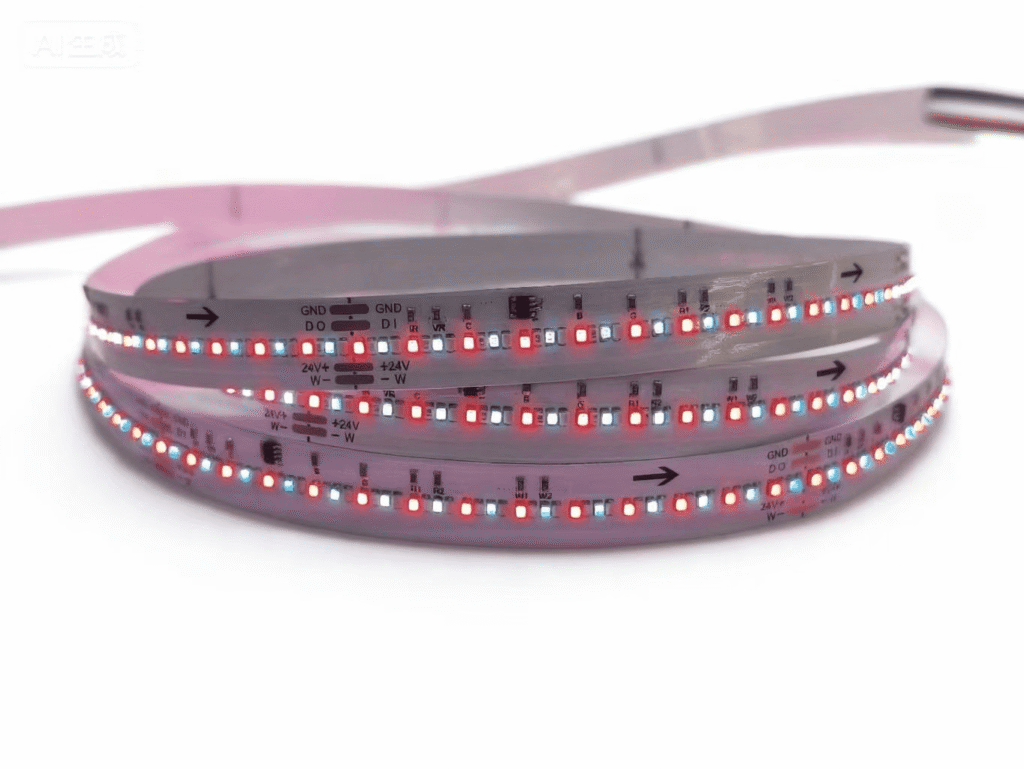
Table of Contents
- What Are Addressable RGB LED Strip Lights?
- How Digital ICs Control Your Lighting
- Addressable RGB LED Strip Lights vs. Standard RGB: A Comparison
- Common IC Types: WS2811, WS2815, and UCS1903
- Understanding Digital Protocols: SPI vs. DMX512
- Voltage Selection for Addressable RGB LED Strip Lights
- Addressing the Data Signal: Why Backup Data Lines Matter
- Power Management for Large-Scale Pixel Projects
- Protecting Addressable RGB LED Strip Lights with IP Ratings
- A B2B Sourcing Checklist for Digital Lighting
- Conclusion: Partnering for Innovation
1. What Are Addressable RGB LED Strip Lights?
Addressable RGB LED Strip Lights are also known as “digital” or “pixel” strips. Unlike standard strips, they contain tiny Integrated Circuits (ICs). These ICs act like small computers. They listen to a data signal and tell each LED exactly what to do.
This allows for incredible effects. You can create chasing “rainbow” effects. You can display scrolling text. You can even turn a whole building into a giant video screen. For B2B projects, Addressable RGB LED Strip Lights provide the ultimate creative freedom.
2. How Digital ICs Control Your Lighting
The “brain” of the system is the IC. On Addressable RGB LED Strip Lights, the IC can be inside the LED chip or mounted on the PCB.
- Internal IC: This looks cleaner. Each LED is one “pixel.”
- External IC: One IC usually controls a group of 3 or 6 LEDs. This is common in 12V or 24V systems.
The IC receives a “packet” of data. It takes the color information meant for its LEDs. Then, it passes the rest of the data to the next IC in the line. This is why we call it a “daisy-chain” system.
3. Addressable RGB LED Strip Lights vs. Standard RGB: A Comparison
If you are a procurement manager, you need to know which one to buy.
| Feature | Standard RGB Strip | Addressable RGB LED Strip Lights |
| Color Control | Entire roll changes together | Each LED/Pixel is independent |
| Wiring | 4 Wires (R, G, B, +) | 3 or 4 Wires (+, -, Data, Clock) |
| Controller | Simple Analog Controller | Digital/Pixel Controller |
| Complexity | Low | High |
| Price | Lower | Higher |
Standard RGB is great for simple mood lighting. However, Addressable RGB LED Strip Lights are necessary for any project that needs “movement” or “animation.”
4. Common IC Types: WS2811, WS2815, and UCS1903
Choosing the right IC is the most important part of sourcing Addressable RGB LED Strip Lights.
4.1 WS2811 (The Industry Classic)
This is an external IC. It is very common in 12V systems. One IC controls 3 LEDs. It is reliable and cost-effective for large projects.
4.2 WS2815 (The Reliable 12V Choice)
This is a “Dual-Signal” IC. This is huge for B2B buyers. In older strips, if one LED broke, the whole strip after it stopped working. In WS2815 Addressable RGB LED Strip Lights, there is a backup data line. If one LED fails, the signal keeps moving. This reduces maintenance costs.
4.3 UCS1903 (Popular for Facades)
UCS1903 is very stable for long-distance data transmission. We often use this in our [Silicone Neon Flex] products for outdoor building outlines.
5. Understanding Digital Protocols: SPI vs. DMX512
How does your controller talk to the Addressable RGB LED Strip Lights? There are two main ways.
- SPI (Serial Peripheral Interface): This is the most common for LED strips (like WS2811). It is fast and can control thousands of pixels. However, the signal can only travel a short distance (usually under 5 meters) without a “data booster.”
- DMX512: This is the professional standard for stage and architectural lighting. DMX is very robust. It can travel long distances without interference. We manufacture specialized DMX512 Addressable RGB LED Strip Lights that connect directly to professional lighting consoles.
[Read our guide on DMX vs. DALI protocols for more details.]
6. Voltage Selection for Addressable RGB LED Strip Lights
Voltage is a major factor in pixel projects.
- 5V: Common for small hobby projects. It has terrible voltage drop. We rarely recommend this for B2B installations.
- 12V: A good balance. It is common for WS2811 and WS2815.
- 24V: The best choice for professional projects. 24V Addressable RGB LED Strip Lights can run longer distances with less power injection.
[Struggling with dimming at the end of your run? Read our LED Strip Voltage Drop Solutions.]
7. Addressing the Data Signal: Why Backup Data Lines Matter
In large-scale installations, reliability is everything. Imagine a building facade with 1,000 meters of lights. If one pixel fails, you don’t want a “black hole” in your design.
Always specify Addressable RGB LED Strip Lights with “Breakpoint Resume” or “Dual Data” lines. This means the strip has two paths for the signal. If the primary path is blocked by a broken chip, the secondary path takes over. This feature is a “must-have” for any high-end commercial project.
8. Power Management for Large-Scale Pixel Projects
Addressable RGB LED Strip Lights consume a lot of power when all LEDs are white.
- Calculation: A typical strip might use 14.4 Watts per meter. For 100 meters, that is 1,440 Watts!
- Power Supplies: You need multiple high-quality, fan-cooled power supplies.
- Safety: Use fuses for every 5-meter or 10-meter branch. This prevents a short circuit from damaging your expensive digital controller.
Expert Advice: Always use a 20% “safety margin” for your power supplies. [Check the international electrical safety standards for LED installations.]
9. Protecting Addressable RGB LED Strip Lights with IP Ratings
Most digital projects are outdoors. You need to protect the sensitive ICs from water and dust.
- IP65: Silicone coating. Good for temporary indoor events.
- IP67/IP68: Full silicone extrusion. This is the only choice for permanent outdoor facades.
We use [Silicone Extrusion Technology] to seal our Addressable RGB LED Strip Lights. Silicone does not yellow. It protects the ICs from freezing temperatures and extreme heat.
10. A B2B Sourcing Checklist for Digital Lighting
When you are ready to buy from www.henleled.com, use this checklist:
- Which IC is used? (Demand WS2815 or UCS1903 for reliability).
- Does it have a backup data line? (Essential for facades).
- What is the refresh rate? (Higher is better for smooth video).
- Is the PCB 3oz copper? (Digital chips generate local heat; thick copper is vital).
- Is it compatible with my controller? (Check SPI vs. DMX).
11. Conclusion: Partnering for Innovation
Addressable RGB LED Strip Lights are complex but rewarding. They allow you to create lighting that lives and breathes. However, they require a high-quality manufacturer and careful engineering.
At Henle LED, we specialize in digital solutions. We provide the technical support you need for wiring, controller selection, and power management. We ensure your Addressable RGB LED Strip Lights are tested and ready for the most demanding environments.
Ready to start your digital lighting journey? Contact our expert team today at www.henleled.com. We can provide custom pixel pitches, specialized ICs, and waterproof solutions for your next landmark project. Let’s make your vision move!